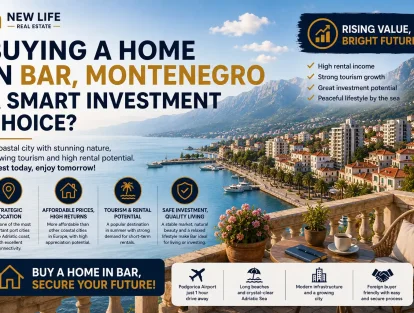



Montenegro offers a wide variety of options for those looking to buy a home along the Adriatic coast. Although the country’s coastline isn’t very long, there are areas catering to different preferences—from the tranquil shores of the Bay of Kotor to the lively beaches of Budva, and from the modern marina life of Tivat to the long sandy beaches of Ulcinj. This diversity makes it difficult to answer the question, “Where can you buy a beachfront home in Montenegro?” with just one city name.
This is because when purchasing a waterfront home, distance from the sea isn’t the only factor that matters. The lifestyle of the area where the property is located, how active it is throughout the year, transportation options, the type of development, tourist demand, and the property’s legal status also directly influence the decision. For example, while an old stone house in the Bay of Kotor and a residence in a modern marina project in Tivat might both be classified under the “beachfront” category, the lifestyle and investment profiles they offer are quite different.
Another important point here is that the terms “direct waterfront,” “near the sea,” and “sea view” used in listings do not all mean the same thing. A property with a sea view may be located hundreds of meters from the shore or on a high vantage point. A “near the sea” home, on the other hand, might be just a few minutes’ walk from the shore but could have other buildings blocking the view. For a property that is truly “directly on the water,” the property’s location along the shoreline, parcel boundaries, and access to the sea must be examined separately.
For this reason, before you start looking for a beach house in Montenegro, the first question should not be “Which is the most beautiful city?” but rather “What kind of beach lifestyle do I want?” The areas that a buyer seeking to live in a historic bay town should consider differ from those of a buyer looking for modern marina living or wanting to invest in a bustling beach area.
The Best Areas to Buy a Waterfront Home in Montenegro
Montenegro’s Adriatic coast is home to numerous coastal settlements, including Herceg Novi, Kotor, Tivat, Budva, Bar, and Ulcinj. However, the real estate characteristics of these areas vary significantly. While some are characterized by historic stone buildings and small coastal towns, others are dominated by new residential projects, marinas, and modern apartment complexes.
For this reason, those looking for waterfront homes should consider the lifestyle the region offers rather than simply comparing cities based on price.
Kotor: Options That Combine Historic Charm with Gulf Living
When it comes to waterfront homes in Montenegro, the Bay of Kotor is one of the first regions to consider. Surrounded by mountains, with its historic settlements and stone houses lining the coast, Kotor possesses a character quite distinct from that of a classic Mediterranean coastal city.
In particular, Dobrota, Prčanj, and Muo are settlements frequently encountered by those seeking coastal real estate around the center of Kotor. Residential options ranging from old stone houses to more modern apartments and villas can be found at various points around the bay. Perast and its surroundings, on the other hand, are a special area where historic architecture is much more prominent, and preserving the character of the built environment is of great importance.
One of
Kotor’s key advantages is that the sea is not merely a vacation destination used only during the summer months. The settlements along the bay offer a unique way of life year-round. Living in a home that opens directly onto the bay in the morning, walking to the center along small coastal paths, and being part of the historic surroundings set Kotor apart, especially for those seeking real estate to live in.
However, when purchasing a “waterfront” home in Kotor, it is essential to look beyond the romantic imagery. Particularly in older buildings, the technical condition of the structure, its restoration history, lot boundaries, vehicle access, and parking availability must be carefully examined. Some historic buildings very close to the shore may lack features expected of a modern residence, such as parking, a spacious terrace, or easy vehicle access.
Furthermore, the fact that a property in the bay overlooks the sea does not necessarily mean it has exclusive access to the shoreline. A public coastal road may run in front of the house, or the coastal area may have a different legal status. For this reason, especially for first-row properties, it is essential to verify before purchase whether the title deed and cadastral records align with the actual use of the property.
With these characteristics, Kotor is a strong option for buyers who prioritize a historic atmosphere, a tranquil bay lifestyle, and distinctive real estate. However, for those seeking new construction, extensive social amenities, and a modern community lifestyle, Tivat may be a more suitable alternative.
Tivat: Modern Marina Living and Premium Residences
While Kotor stands out for its historic character, Tivat is one of the areas along the Montenegrin coast where modern transformation is most evident. Large-scale projects such as Porto Montenegro and Luštica Bay are among the key factors transforming Tivat from a classic coastal town into an international marina and residential destination.
Consequently, the search for waterfront homes in Tivat has a different profile than in Kotor. Here, alongside historic stone houses, modern residences, premium apartments around the marina, new villas, and projects offering comprehensive amenities take center stage.
The area around Porto Montenegro is particularly appealing to those seeking real estate centered on marina living. The combination of restaurants, shops, marina services, and social life offers a significant advantage, particularly for buyers who live in Montenegro during certain times of the year or expect services that meet international standards.
Another important area in
Tivat is the Luštica Peninsula and the surrounding Luštica Bay. Unlike the classic apartment buildings in the city center, the residential structure here is developing through projects that combine planned communities, villas, marina life, and beach life. For this reason, Tivat is a very strong alternative for buyers who say, “When I step out of my home, I want to be right in the midst of a planned coastal lifestyle.”
In areas such as Donja Lastva, Seljanovo, and Krašići, it is possible to find a variety of budgets and housing types. Thus, the Tivat option is not limited solely to high-end projects within the marina.
However, an important distinction must be made here. Not every residence in a marina or coastal project is truly right on the water. An apartment located on the second or third level of a project may have a stunning sea view, but there may be other buildings, common areas, or marina facilities in front of it. Therefore, when making a purchase decision, one should evaluate the property’s actual location on the lot rather than relying solely on the marketing description.
Tivat is one of Montenegro’s leading regions, particularly for buyers seeking new construction, modern architecture, marina living, easy access to services, and a more premium environment. In contrast, Budva offers distinct advantages for those seeking a more vibrant beach lifestyle and proximity to tourist centers.
Budva: Beach Life and a Vibrant Real Estate Market
Budva is one of the most well-known tourist destinations along the Montenegrin coast. Therefore, purchasing a home right on the water or very close to the sea here means not only living on the Adriatic coast but also owning real estate in one of the country’s most vibrant tourist regions.
What sets Budva apart is that its coastal lifestyle is more beach-focused compared to Kotor and Tivat. Along the coastline stretching from downtown Budva toward Bečići, Rafailovići, Pržno, and Sveti Stefan, you’ll find settlements, each with its own distinct character.
Budva’s city center is ideal for those seeking easy access to restaurants, shops, nightlife, and daily amenities. However, the crowds and traffic that come with the peak tourist season are factors that buyers seeking a quiet coastal lifestyle should carefully consider.
Bečići and Rafailovići attract buyers who prioritize access to the sea and beaches, thanks to housing options located near wide beaches. Here, you can find new apartment projects, residences, and homes with panoramic sea views as they rise up the hillsides. However, just because a hillside property has a stunning view of the Adriatic doesn’t mean it’s right on the water. This distinction is particularly important when comparing listings in Budva.
The areas around
Pržno and Sveti Stefan, on the other hand, have a distinctly different atmosphere. With its small coves, rich Mediterranean character, and more exclusive residences, this stretch is worth considering for buyers who prefer to avoid the hustle and bustle of downtown Budva but do not want to stray too far from the Budva Riviera.
Purchasing beachfront real estate in Budva also involves a distinct dynamic from an investment perspective. High tourist demand can create opportunities for short-term and seasonal rentals; however, one should not act solely on the assumption that “it’s easy to rent out simply because it’s close to the sea.” The age of the building, parking availability, actual walking distance to the beach, new construction in the surrounding area, maintenance costs, and the times of year when the property is available for use should all be evaluated together.
In particular, whether the view will be preserved in the future is an issue that should not be overlooked. Making a decision based solely on the current view—without knowing the zoning and development conditions surrounding a property that currently has an empty lot in front of it and an unobstructed ocean view—could pose a risk.
For this reason, Budva is a strong option for those who want to be close to the beach, remain connected to social life, and consider the property not only for personal use but also for seasonal rentals. Conversely, Herceg Novi should also be considered for buyers seeking a quieter bay lifestyle, Bar for those preferring a more established city life, and Ulcinj for those prioritizing long sandy beaches.
Herceg Novi: A Quieter and Greener Bay Lifestyle
Herceg Novi is one of the standout areas in Montenegro for those looking for a waterfront home but preferring a more peaceful environment than the bustling tourist activity of Budva or the marina-centered lifestyle of Tivat. Located at the entrance to the Bay of Kotor, the city—with its settlements stretching along the coast, lush greenery, and neighborhoods bustling with life for most of the year—is worth considering not only for vacation purposes but also for long-term living.
When searching for coastal real estate in Herceg Novi, it’s important not to think of the city as a single, unified center. Igalo, Topla, Savina, Kumbor, Đenovići, Baošići, and Bijela are settlements that follow one another along the coast but each possess distinct characteristics. As a result, within the same municipal boundaries, it is possible to find both an apartment close to the bustling central areas and a detached house or villa in a quieter coastal settlement.
Savina, while close to the city center, stands out for its quieter and greener surroundings. In this area, which features apartments with sea views and single-family homes, it is relatively easy to access daily amenities and the center of Herceg Novi. It is one of the areas worth considering for those seeking a quieter lifestyle without losing touch with the city’s historic character.
As we head east along the bay, Kumbor and Đenovići offer a different real estate profile. In particular, the marina and new residential developments have transformed the character of this stretch. For those seeking modern housing who do not wish to completely give up the atmosphere of a small coastal settlement, these areas can serve as an alternative to Tivat.
In the Baošići and Bijela areas, the residential fabric becomes more focused on daily life. In addition to homes near the coast, as you move slightly inland from the sea, you’ll find detached homes on larger plots and villas with views of the bay.
Due to Herceg Novi’s geographical structure, special attention should be paid to the distinction between “sea-view” and “waterfront” properties here as well. The city is situated on terrain that rises from the shoreline. As a result, even homes located at a certain distance from the sea can offer quite impressive views of the bay. However, a stunning view does not necessarily mean the property is located right on the shore.
If a property is being evaluated as a true “first-row” property, the status of the area between the home and the sea must be investigated separately. Due to walking paths, small piers, and public areas along the shoreline, the fact that a home is physically located right next to the sea does not necessarily mean that the property has exclusive rights to the shoreline.
With these features, Herceg Novi is a strong option for those seeking a peaceful bay lifestyle, a green environment, and a coastal area suitable for year-round living. It should be specifically included in the comparison for buyers who do not require Tivat’s premium marina atmosphere but wish to remain in the Kotor Bay area.
Bar: For Those Seeking a Blend of Coastal Living and Daily City Life
When searching for real estate along the Montenegrin coast, Bar may not enjoy the same international recognition as Budva, Kotor, or Tivat. However, the city offers significant advantages, particularly for those who wish to live in Montenegro year-round rather than just vacation there.
One of Bar’s key distinguishing features is its city structure that functions independently of tourism. Thanks to its port, rail connections, public services, shopping options, healthcare services, and resident population, daily life continues year-round. This makes the region particularly worth considering for those thinking of buying a home near the sea and settling permanently in Montenegro.
While the center of Bar features apartments and new residential projects close to the coast, the nature of real estate options begins to change as you move away from the center. Šušanj and Zeleni Pojas are among the areas that maintain proximity to the center while offering sea views and a greener environment for those seeking such features.
Further south, Dobra Voda and Utjeha offer options where the coastal lifestyle is more pronounced. In addition to apartments, these areas also feature single-family homes and villas. Due to the topography, homes situated on elevated points along the coast may offer expansive views of the Adriatic.
When searching for property in Bar, it’s important to pay attention to location descriptions. Especially in hillside areas, a home that appears quite close to the sea as the crow flies may be harder to reach on foot than expected. A distance that appears to be 300–400 meters on a map can create a different experience in daily life due to sloping roads and the lack of direct access.
For this reason, when evaluating homes near the sea in Bar and the surrounding area, one should look not only at the distance in kilometers or meters but also at the actual travel route. Is it possible to walk to the beach from the property’s location? How steep is the path? If driving, is there parking available? Is it easy to access daily groceries and other necessities? These questions are just as important as the sea view itself, particularly for long-term living.
For properties that are truly right on the water, the coastal status, parcel boundaries, and the legal status of the structure must be thoroughly investigated. Particularly in single-family homes, it should not be assumed that terraces, auxiliary structures, or other additions built later are in compliance with land registry and cadastral records.
In conclusion, Bar offers a balanced alternative for buyers who want to live on the Adriatic coast but do not wish to be cut off from daily city life and essential services. While it has significant tourist potential during the summer months, it requires a different assessment from Budva for buyers who prioritize year-round living.
Ulcinj: Long Beaches and a More Natural Coastal Character
Located at the southernmost tip of Montenegro’s coastline, Ulcinj features a geography that distinctly sets it apart from the country’s other coastal cities. Unlike the narrow coastal strip where the mountains meet the sea in the Bay of Kotor or the coves in Budva, Ulcinj is characterized by long sandy beaches and wider, flatter areas.
This distinction places Ulcinj in a category of its own for those seeking homes right on the water or near the shore in Montenegro.
Apartments, single-family homes, and villas with sea views can be found in the city center and around Pinješ. Pinješ’s elevated terrain offers an advantage, particularly for those seeking panoramic sea views. However, it is important to distinguish between enjoying an unobstructed view of the sea from a high vantage point and truly living right on the coast.
Ulcinj’s most distinctive area, however, is the stretch between Velika Plaža and Donji Štoj. With its sandy beach stretching for kilometers, Velika Plaža offers a living environment entirely distinct from Montenegro’s other popular coastal regions. Those searching for seaside properties in this area are more likely to find single-family homes, tourist facilities, and structures on larger lots rather than classic city apartments.
This feature particularly sets Ulcinj apart for buyers who prefer “a wide sandy beach in front of my home rather than a marina or rocky shore.”
However, the region’s more natural and low-density appearance does not mean that the real estate review process is simpler. On the contrary, land status, zoning conditions, building permit status, and cadastral records for plots near the coast must be examined very carefully. You must ensure that what you are purchasing is not just the existing structure, but a legally registered and usable piece of real estate.
When evaluating Ulcinj, the island of Bojana often comes up as well. Although the region’s unique structures, directly connected to the water, may seem quite attractive, one should not proceed as if purchasing a standard city apartment here. Due to property ownership restrictions related to the island, the coastline, and certain types of land, foreign buyers should not make a purchase decision without first having the legal status of the property professionally investigated.
Another characteristic of Ulcinj is the difference in activity levels between summer and winter. While areas such as Velika Plaža and Donji Štoj can be quite bustling during the summer months, these same areas take on a much quieter character during the off-season. For this reason, rather than visiting the region only during a summer vacation and making a decision to live there long-term, it would be wiser—if possible—to assess how the region functions during different times of the year.
Ultimately, Ulcinj stands out for those who prefer long sandy beaches, more open spaces, and a coastal lifestyle distinct from that of Montenegro’s northern coastal cities. It is one of the areas that buyers who are not looking for Kotor’s historic charm, Tivat’s marina life, or Budva’s bustling social scene—but instead seek a more natural and spacious coastal environment—should definitely consider.
“Direct Beach Access” Is Not the Same as “Ocean View”
When searching for real estate in Montenegro’s coastal region, some of the most common phrases encountered in listings are “direct beachfront,” “near the sea,” and “sea view.” While these terms may seem similar at first glance, they carry significant differences in terms of the property’s location and intended use.
A “direct beachfront” home generally refers to a property located in the first row along the shoreline. However, the fact that the home is right next to the sea does not mean the property owner has exclusive rights to the area between the home and the sea. On the Montenegrin coast, a walking path, local road, or public coastal area may run directly in front of the house. Therefore, the term “directly on the water” alone does not guarantee a private beach, a private pier, or exclusive access to the water for the property owner.
In the case of homes near the sea, the property may not be in the first row along the shoreline but may still be a short distance from the beach or shoreline. Here, relying solely on the distance in meters specified in the listing can be misleading. In certain regions of Montenegro—particularly Kotor, Herceg Novi, Budva, and Bar—the terrain can rise steeply over short distances. Reaching a home that appears to be 300 meters from the shore on a map may be more difficult in daily use than expected due to a steep slope.
The definition of a “sea-view home,” however, is broader. Even if a property is quite far from the sea, its elevation may still provide a panoramic view of the Adriatic or the Bay of Kotor. Numerous examples of this can be found on the hillsides around Budva, in Herceg Novi, and at certain points along the Bay of Kotor.
For this reason, when evaluating a listing, one should look at the property’s actual location on maps and cadastral records rather than relying solely on the terminology used or professionally taken photographs. The plots, roads, and structures between the home and the sea should be examined; if possible, access to the shore should be experienced firsthand.
When purchasing a home with a sea view, the possibility of future development is also a significant consideration. An unobstructed sea view may currently be enjoyed thanks to an empty lot in front of the house. However, if development on that lot is possible in the future, part or all of the existing view could be blocked. For this reason, especially in cases where the view plays a significant role in the property’s value, it is essential to research the surrounding zoning regulations.
For a property that is truly right on the water, the key question to ask is not merely “How many meters from the water?” but “Where does the property line end, and where does the shoreline begin?”
What to Consider When Buying a Waterfront Home in Montenegro?
Waterfront properties can be quite attractive due to their location. However, when purchasing a property on the shoreline, a more thorough review may be necessary than for a standard city apartment. Particularly for older beach houses, stone structures, detached villas, and lots directly adjacent to the shoreline, it is important to verify that the property’s current use aligns with official records.
Before making a purchase decision, the following points must be verified:
- Title deed and cadastral records: The seller’s ownership rights to the property, the registered area of the property, and details regarding the independent unit must be verified.
- Lot boundaries: It must be determined whether areas such as gardens, terraces, parking lots, or spaces used facing the sea are actually included in the lot to be purchased.
- Mortgages, encumbrances, and other obligations: It must be investigated whether there are any third-party rights or other entries on the property that could affect the transfer of ownership.
- Legal status of the structure: It must be examined whether the existing building and any subsequent additions are in compliance with official records.
- Zoning conditions: Not only the parcel to be purchased but also neighboring parcels—particularly those that could affect the ocean view—should be evaluated.
- Beach access: It should be determined how the property, marketed as “direct beachfront,” actually provides access to the sea.
- Vehicle and parking access: Especially in older neighborhoods in the Bay of Kotor, access to the home by car or private parking may not always be possible.
- Technical condition of the building: Due to the sea air and high humidity, the condition of the exterior facade, roof, window and door frames, metal components, insulation, and plumbing and electrical systems must be inspected.
- Common areas and expenses: For properties within a residence or gated community, the annual costs for the pool, security, marina services, and other common areas should be determined.
- Intended use: Will the property be purchased solely for personal use, used year-round, or rented out during specific periods? The choice of location should be made accordingly.
Especially when purchasing an old stone house or a detached villa, one should not assume that “everything you see is included in the title deed.” The legal status of a terrace that has been in use for years, a specific section of the garden, a pier, or an auxiliary structure may differ from that of the main property.
In new developments, however, the nature of the risks changes. Here, the developer’s standing, the project’s permits, delivery terms, the ownership and usage arrangements for common areas, maintenance fees, and the technical specifications of the purchased unit as outlined in the contract take on greater importance.
Technical inspections should not be overlooked for waterfront homes. Salty sea air can create a greater need for maintenance—particularly on metal surfaces, exterior facade elements, and mechanical systems—compared to buildings in inland areas. In very old buildings, moisture and waterproofing are also among the issues that must be checked before purchase.
From the perspective of a foreign buyer, it must also be verified whether the property is eligible for foreign ownership. While foreigners can acquire real estate in Montenegro, restrictions may apply to certain land and property categories. Particularly when it comes to coastal areas, islands, or parcels with different land statuses, one should not proceed as if purchasing a standard apartment unit.
The purpose of these checks is not to unnecessarily complicate the purchase process, but to determine whether the legal and technical characteristics of a property with high market value truly align with its sale price.
Which Area Is Best for You?
For those looking to buy a waterfront home in Montenegro, there is no single “best city.” The right area depends on how the property will be used and the kind of lifestyle the buyer desires.
Tivat is a strong option for those prioritizing modern architecture, marina living, and premium residential projects. Those who want to live in a new or relatively new building, be close to restaurants and amenities, and enjoy a more planned living environment can consider options around Porto Montenegro, Luštica Bay, and Tivat.
Kotor appeals to buyers seeking character rather than modern developments. The stone houses and coastal residences in Dobrota, Prčanj, Muo, and other historic settlements along the bay offer a distinct lifestyle experience on the Adriatic coast. However, this may require further research into the technical condition of older buildings, as well as parking and vehicle access.
Budva stands out for those who prioritize beaches and a vibrant social life. The Budva Riviera is also worth exploring for those who wish to use their property not only for personal use but also for seasonal rentals. However, the peak season, traffic, and surrounding development should also be factored into the decision.
Herceg Novi is worth considering for those seeking a quieter, greener lifestyle in the Bay of Kotor. Especially for long-term living, in addition to the center of Herceg Novi, Savina, Kumbor, Đenovići, and other settlements along the coast offer diverse options.
Bar appeals to those who prefer to combine daily city life with access to the sea rather than living in a tourist hub. If year-round access to public services, transportation, and daily necessities is important, Bar and its immediate surroundings can be a strong alternative.
Ulcinj, on the other hand, differs from the other five regions by offering long sandy beaches and a more open coastal landscape. The areas around Velika Plaža and Donji Štoj are particularly appealing to those who want to be close to wide beaches.
However, the process isn’t over once you’ve chosen a city. Even two neighborhoods within the same city—or even two properties within the same neighborhood—can have completely different characteristics. For example, an apartment just a few steps from the beach in Budva is not used in the same way as a home with a panoramic view in the upper part of Bečići. Similarly, a marina residence in the center of Tivat and a villa on the Luštica Peninsula may not appeal to the same buyer profile.
Therefore, when selecting a region, you should first determine your lifestyle goals, budget, property type, and the relationship you wish to have with the sea; the choice of city and neighborhood should follow. “Being right on the water” alone is not a sufficient criterion for selecting the right property.
Is Investing in Waterfront Homes in Montenegro a Sound Choice?
Just as in many coastal markets around the world, waterfront properties are a sought-after category in Montenegro due to the limited supply of coastal land. However, the mere fact that a home is located right next to the sea does not automatically mean it is a good investment. The property’s location, legal status, construction quality, accessibility, and future usage potential must all be evaluated together.
First and foremost, the investment dynamics of beachfront properties differ from those of properties with ocean views. The supply of new homes with ocean views may increase, particularly in areas where there are open spaces available for new development on hillsides. However, the areas where properties can truly be built on the very first line of the coast are geographically limited. That said, this limitation does not mean that every first-line property is automatically valuable or liquid.
For example, an old stone house located right next to the sea in the Bay of Kotor may have a very special location. However, if it requires extensive restoration, lacks vehicle access, or has legal issues related to the property, it would be incorrect to evaluate it based solely on its location. Similarly, a modern apartment in Budva located very close to the beach may have a strong location, but high common area fees or dense surrounding development could impact its investment performance.
When purchasing a coastal property for investment purposes, the following four factors in particular should be considered together: location, legal security, usability, and demand.
Location does not merely refer to the distance to the sea. Access to restaurants, grocery stores, the airport, the city center, and major transportation routes is also important. Especially if short-term use is the goal, even whether a guest or user is required to use a vehicle to reach the beach can affect the property’s appeal.
Legal security takes on even greater importance for coastal properties. A property that appears very attractive but has issues regarding parcel boundaries, building registrations, or usage rights could complicate the sales process in the future. For this reason, investment value should not be calculated solely based on the purchase price and expected rental income.
Another important consideration is how much of the year the property is available for use. In tourist areas such as Budva or Ulcinj, some locations may see very strong demand during the summer months but be quieter during the off-season. In regions like Tivat, Kotor, Herceg Novi, and Bar, however, the usage profile may vary throughout the year depending on the specific location.
For someone buying a home for their own use, however, investment return does not have to be the sole criterion. Waking up just a few steps from the sea, living in the unique atmosphere of a private bay, or being able to walk to the beach can be motivations for purchase in and of themselves. For this reason, the “best investment” and the “right home to live in” are not always the same property.
When evaluating a waterfront home in Montenegro, the potential for future resale should also be considered. A very unique and expensive property may command high prestige, but its potential buyer base may be narrower. In contrast, a beachfront home in the right location—one that is easily accessible and practical—can appeal to a broader group of buyers.
Therefore, when deciding whether a beachfront home makes sense as an investment, rather than relying solely on the “it gains value just because it’s on the coast” approach, the purchase price, location quality, legal status, usage potential, maintenance costs, and future buyer demand should all be evaluated together.
How Does the Process of Buying a Waterfront Home in Montenegro Work?
Finding a desirable beachfront property in Montenegro is just the beginning of the purchasing process. Especially for a foreign buyer, the property’s legal status must be thoroughly examined before any payment is made or the final contract is signed.
In the first stage, the property to be purchased is identified, and its ownership status is verified through cadastral records. It must be verified whether the owner listed in the records is the same person as the seller, whether there are any mortgages or other encumbrances on the property, and whether the registered property information matches the actual conditions.
For waterfront properties, this review must also include the parcel boundaries. Particularly in the case of single-family homes and villas, it should not be assumed that the entire garden, terrace, parking area, or waterfront usage areas belong to the property being purchased.
Following the legal review, the parties agree on the terms of sale. Depending on the nature of the transaction, the process may proceed to a preliminary contract or directly to the final sales contract. It is important that matters such as the payment plan, delivery conditions, and any deposit or down payment be clearly specified in the contract.
In real estate sales transactions, the notary stage is one of the fundamental parts of the purchase process. However, one should not assume that the process is completely over with the signing of the contract. The registration of the property in the new owner’s name with the cadastre is one of the critical stages of the ownership process.
In general, the process can be outlined as follows:
Identification of the property → title deed/cadastral and legal review → agreement on price and terms of sale → preparation of necessary contracts → notary procedures → payment → cadastral registration → handover
If the purchase involves a new development or a property that has not yet been completed, the scope of the review will differ. In this case, the evaluation must extend beyond the existing unit to include the project’s permits, the developer’s obligations, the delivery date, the technical specifications, common areas, and the provisions in the contract regarding delays.
For a pre-owned beach house, the physical condition of the structure takes on greater importance. Particularly in older stone houses or standalone structures that have been in use for many years, having a technical inspection conducted in addition to the legal review can help anticipate high maintenance and renovation costs that may arise in the future.
Foreign buyers must also verify, prior to the transaction, whether the property to be purchased is subject to any restrictions on foreign ownership. It is incorrect to evaluate a standard residential property in the same way as land or coastal parcels with special status.
The goal is not to sign the contract as quickly as possible, but to complete the transaction with the assurance that the purchased property meets the expected legal, technical, and physical criteria.
There Is No Single “Right” Area for a Beachfront Home in Montenegro
Montenegro’s coastline brings together quite different lifestyles within a small geographical area. For this reason, it is not possible to answer the question, “Where should one buy a beachfront home in Montenegro?” with a single city that applies to everyone.
While Kotor offers a coastal lifestyle characterized by historic stone buildings and the unique atmosphere of Boka Kotorska, Tivat has a completely different profile with its modern marina projects and premium residential developments. While Budva is known for its beaches and vibrant social life, Herceg Novi offers a quieter, greener alternative in its bay. Bar combines coastal living with a city that’s bustling year-round, while Ulcinj stands out for its long sandy beaches and more natural coastal character.
Therefore, the first step in choosing the right area is to clearly define your expectations before considering your budget.
Will you be living there year-round? Will you use the home only during the summer months? Are you looking for a modern residence, a historic stone house, or a standalone villa? Is walking to the beach sufficient, or do you really want to be right on the waterfront? Is the property being purchased for personal use or as an investment?
Once the answers to these questions are clear, comparing options along the Montenegro coast becomes much easier.
Most importantly, you shouldn’t make the phrase “right on the water” your sole purchasing criterion. The property’s title and cadastral status, parcel boundaries, actual access to the sea, technical specifications, transportation, and future development conditions in the surrounding area must all be evaluated together.
Through Newlife Guide, you can explore options for homes, apartments, and villas for sale in different coastal regions of Montenegro and compare areas that align with your lifestyle expectations, budget, and investment goals. Once you’ve identified the right location, it becomes much easier to select not just a property near the sea, but the right home that will meet your needs in the long term.



 +382 69 980 968