


One of the first questions people considering real estate investment in Montenegro usually ask is: Which city should I buy a home in? Considering Tivat’s luxury marina projects, Budva’s robust tourism market, Kotor’s limited yet distinctive housing stock, Podgorica’s year-round rental demand, or Bar’s relatively affordable prices, it’s not easy to name just one city.
Moreover, “the best city for investment” does not mean the same thing as “the city that will appreciate the most” or “the city that will provide the highest rental yield.”
According to the latest data published by the Montenegrin Statistical Office (MONSTAT) in August 2026, the average sales price for new residential properties reached 2,557 €/m² nationwide in the second quarter of 2026. In Podgorica, the average was 2,510 €/m², while in the coastal region it stood at 2,838 €/m². In the previous quarter, these figures were 2,395 €/m² and 2,575 €/m², respectively. However, it is important to note that MONSTAT’s data covers only new residential properties sold on the market for the first time; it does not include resale properties, villas, or land lots.
Therefore, selecting a city for investment based solely on the average price per square meter is not the right approach. The purchase cost, rental model, tourism demand, resale potential, new supply in the region, and investment horizon must all be evaluated together.
First, You Need to Determine What Constitutes the “Best Investment”
What is the right city for one investor may be the wrong choice for another.
For example, from the perspective of an investor seeking a steady and as predictable as possible monthly rental income, Podgorica may be a strong option. For someone looking to benefit from short-term rentals during the summer season, Budva may offer a more suitable market. An investor with a high budget who prioritizes long-term value preservation in the premium segment, on the other hand, may turn to Tivat.
Therefore, before comparing cities, it’s wiser to categorize investment goals into four basic groups:
- Steady long-term rental income
- Tourism and short-term rental potential
- Long-term appreciation
- Capital preservation in premium real estate
The investment profiles of cities in Montenegro vary significantly depending on these objectives.
Budva: One of the Strongest Candidates for Tourism and Short-Term Rentals
When discussing tourism-focused real estate investment in Montenegro, Budva deserves special mention.
According to MONSTAT’s August 2025 data covering collective accommodation facilities, 466,606 of the 1,061,386 overnight stays across Montenegro took place in Budva. In other words, Budva alone accounted for approximately 44% of the national total in this category. In June 2025, this figure stood at 43.9%.
Moreover, Budva’s dominance does not appear to be limited to the July–August period. Even in the October 2025 collective accommodation data, 48.3% of the country’s total overnight stays took place in Budva.
These figures do not directly reflect the rental income from a single apartment on Airbnb or similar short-term rental platforms. However, they serve as a crucial indicator for understanding the scale of the city’s tourism demand.
In addition to downtown Budva, areas such as Bečići, Rafailovići, Pržno, and Petrovac also offer different investment profiles. Walking distance to the beach, ocean views, parking, building quality, and the layout of the property’s rooms can make a significant difference in short-term rentals.
The downside of Budva, however, is that entry costs are no longer low, and the supply of new housing continues to grow, particularly in popular areas. Therefore, rather than purchasing solely based on the idea that “it will rent just because it’s in Budva,” it is essential to evaluate competing properties in the same area as well.
Who is it best suited for? Investors aiming for tourist rentals, combining personal use with investment, and capitalizing on high-season demand.
Tivat: For the Premium Segment and Long-Term Value
Tivat’s investment story is quite different from Budva’s.
Large-scale projects such as Porto Montenegro and Luštica Bay have established Tivat as one of the premium real estate destinations not only within Montenegro but also in the Adriatic region. Due to marina living, an international user profile, and high-standard new residential projects, entry costs in the region can be significantly higher than the national average.
For this reason, from an investor’s perspective, Tivat should be viewed not as a market for “buying low and earning high rental yields,” but rather as a market for capital allocation in high-quality, limited-availability locations.
This difference is also reflected in rental yields. According to a Global Property Guide study using June 2026 data, the average gross long-term rental yield for apartments in Tivat is calculated at approximately 4.36%. In the same study, the average for Podgorica stands at 5.15%.
This does not mean that Tivat is a bad investment. A higher purchase price can naturally lower the ratio of rental income to property value.
When investing in Tivat, the areas around Porto Montenegro, Seljanovo, Donja Lastva, and Luštica should not be evaluated within the same investment category. The target audience, operating costs, and resale market differ between a residential unit in a premium marina project and a standard apartment within the city.
Who is it best suited for? Investors with a high budget who wish to invest in the premium segment and prioritize long-term value preservation through location quality over short-term maximum rental returns.
Kotor: Limited Supply and the Advantage of a Unique Location
Kotor’s most significant feature from an investment perspective is its real estate environment, which is difficult to replicate.
Due to the geography of Boka Kotorska, as well as its historic settlements and UNESCO-protected areas, it is not possible to build an unlimited number of new homes in certain parts of Kotor. This particularly sets apart the distinctive properties in the areas around Dobrota, Prčanj, Muo, and Perast.
However, the investment logic in Kotor is not the same for every property.
A historic residence within the Old Town, a modern apartment with a sea view in Dobrota, and a restored stone house in Prčanj are three distinct investment opportunities. Maintenance costs, the target tenant demographic, and sales liquidity may vary among them.
Kotor is also a strong tourism destination. In August 2025, approximately 59,000 overnight stays were recorded in collective lodging facilities. In October, with approximately 25,000 overnight stays, it is evident that tourism activity continues even after the peak season. monstat.org
Conversely, selecting the right property in Kotor may require more research than investing in a standard new apartment in Budva. In historic buildings, the technical condition, restoration costs, vehicle access, and parking are particularly important.
Who is it best suited for? Investors seeking properties with limited supply, unique character, and the potential for long-term differentiation.
Podgorica: Year-Round Rental Demand Independent of Tourism
When considering an investment in Montenegro, focusing solely on the Adriatic coast could cause you to overlook a significant opportunity.
The investment model in the capital, Podgorica, is entirely different from that of coastal cities. Demand here comes primarily from city residents, workers, students, public and private sector employees, and long-term tenants—rather than tourists.
This creates a significant advantage for investors: reduced seasonality.
According to calculations by Global Property Guide using June 2026 data, the average gross rental yield in Podgorica stands at approximately 5.15%. The same study estimates gross yields of around 5.60% for studio apartments and 5.59% for one-bedroom apartments. It is important to note that these are approximate gross rates based on listing prices and rental values, and the net yield will be lower once taxes, vacancy periods, and operating expenses are deducted.
Purchase costs in Podgorica are also noteworthy when compared to the coastal region. According to MONSTAT’s second-quarter 2026 data on new housing, the average price in Podgorica is 2,510 €/m², while the average in the coastal region is 2,838 €/m². monstat.org
The downside of Podgorica, however, is the lack of the tourist premium and sea view value found in coastal cities. Consequently, this represents a more traditional residential investment rather than one with very high short-term rental or vacation home premiums.
Who is it best suited for? Investors focused on steady long-term rentals, lower seasonal risk, and rental yield.
Herceg Novi: A More Balanced Alternative in the Bay
From an investment perspective, Herceg Novi is sometimes overshadowed by Tivat and Kotor. Yet the city boasts a strong tourism volume within the Bay of Kotor.
According to August 2025 MONSTAT data, approximately 165,000 overnight stays occurred in collective lodging facilities in Herceg Novi. This figure exceeds those of Kotor and Tivat for the same month and accounts for 15.6% of the national total.
One of the city’s advantages is that it is not centered around a single investment hub. Savina, Igalo, Kumbor, Đenovići, Baošići, and Bijela cater to different budgets and user profiles.
While new investments around Kumbor and Đenovići are strengthening the region’s premium segment, more traditional housing options are available in other neighborhoods.
For this reason, Herceg Novi is worth considering for those looking to invest in the bay area without facing Tivat’s high entry costs.
Who is it best suited for? Investors interested in investing in the bay area but evaluating alternatives outside of Tivat and Kotor.
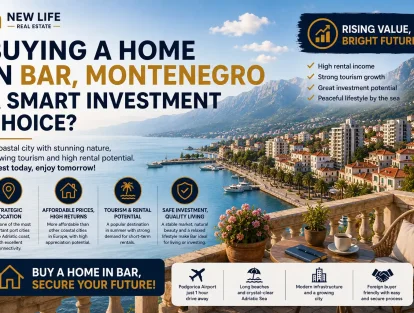
Bar: Lower Entry Costs and Growth Potential
Bar’s strength as an investment destination lies in its ability to combine coastal living with a thriving urban economy.
Unlike a city like Budva, which relies heavily on tourism, Bar’s year-round resident population and port economy create a distinct demand for real estate.
At the same time, Bar can offer more affordable options compared to the premium coastal areas. This allows investors to purchase a larger residence or a different type of property with the same capital.
In areas such as Šušanj, Zeleni Pojas, Dobra Voda, and Utjeha, ocean views and potential for tourist use come into play.
Bar’s investment proposition is based not on being “the most expensive area today,” but on striking a balance between price and potential for use. For this reason, it is one of the cities worth exploring, particularly for investors with a moderate budget.
Who is it best suited for? Investors who want to invest in coastal properties but don’t want to pay the entry costs associated with Tivat, Kotor, and Budva.
Ulcinj: For Those Thinking Long-Term
Ulcinj has a distinct real estate character compared to Montenegro’s other coastal cities. The long sandy beaches around Velika Plaža and Donji Štoj, along with the region’s more expansive land structure and tourism development, form the core of the area’s investment story.
Tourism demand is also significant. In August 2025, Ulcinj accounted for 11% of the national total with approximately 117,000 overnight stays in collective lodging facilities. monstat.org
However, the city center of Ulcinj, Pinješ, Velika Plaža, and Donji Štoj do not share the same investment profile. Particularly for investments in land or standalone properties near the coast, zoning regulations, building permits, and land status must be examined in detail.
Ulcinj may be more appealing to those looking to invest in the region’s future development rather than in an established premium market.
So, Which City Is Really the Better Choice?
Rather than creating a single ranking, it’s more accurate to evaluate based on the investment objective:This table does not imply that “Budva always yields the highest returns” or that “Tivat is guaranteed to appreciate in value.” A poor-quality property in the wrong location within the same city may perform significantly worse than a good-quality property purchased at the right price in another city.
That’s why choosing a city is actually only the first step in the investment decision.
You Need to Evaluate the Property Before the City
One of the mistakes made in real estate investment in Montenegro is forming a strong opinion about a city first and then assuming that any property in that city is a good investment.
In reality, there can be significant differences even between two streets.
For example, in Budva, one of two apartments of the same size might be within walking distance of the beach, have parking, and offer an open-sea view, while the other might be located on a steep slope, require a car, and face the possibility of new construction in front of it.
Similarly, in Tivat, premium residential properties near the marina may come with high sales prices, but also high maintenance fees and operating costs. In Podgorica, on the other hand, a small apartment with a much lower purchase price can yield a higher proportional return on long-term rentals if it is located in the right neighborhood.
For this reason, at least the following factors should be evaluated together when assessing an investment:
Purchase price → actual rental potential → annual expenses → vacancy risk → location → construction quality → legal status → new supply in the area → resale potential.
In particular, claims such as “guaranteed annual returns of 8–10%” mentioned in listings should be scrutinized further. Gross rental income is not the same as the net income that actually ends up in the investor’s pocket.
The Difference Between Gross and Net Returns in Real Estate Investment in Montenegro
When calculating an investment’s annual rental yield, simply multiplying the monthly rent by 12 is not sufficient.
For example, if a residential property valued at 200,000 € generates 12,000 € in annual rental income, a simple calculation shows:
12,000 / 200,000 × 100 = 6% gross rental yield
is obtained.
However, this figure does not represent the investor’s actual return.
Once management fees, maintenance fees, repairs, insurance, taxes, vacancy periods during tenant turnover, and—especially in short-term rentals—cleaning and operating costs are deducted, the net return will be lower.
Therefore, when comparing two cities, instead of simply asking, “Which city has higher rent?” one should consider the question, “How much income do I earn after expenses relative to my invested capital?”
The Best City for Investment Also Depends on Your Budget
As the budget increases, not only do investment options expand, but the nature of the investment also changes.
For more modest budgets, small and medium-sized apartments in Podgorica and residential properties in Bar are worth considering. The goal here is primarily to strike a balance between rental yield and purchase cost.
For medium and high budgets, Budva, Bečići, Herceg Novi, and Kotor begin to offer more options. Tourist rentals and long-term appreciation can be considered together.
For investors with higher capital, Tivat, Porto Montenegro, Luštica Bay, and select locations in the Bay of Kotor fall into a distinct investment category. At this level, investors are not merely purchasing square meters; location, project brand, service level, and access to the international buyer market also become part of the price.
Therefore, it would be incorrect to expect the answer to the question “Which is the best city in Montenegro?” to be the same for an investor with a budget of €150,000 as for one with a budget of €750,000.
What Should Be Considered When Choosing a City for Investment in Montenegro?
When selecting a city, one should consider not only current prices but also the property’s value in five or ten years.
New projects in the region, transportation investments, tourism development, and new housing supply should be monitored; at the same time, the property’s title and cadastral records, structural condition, and any associated liabilities—if any—must be professionally verified.
Especially for foreign investors, a real estate property presented as a “bargain-priced opportunity” should not be purchased without first understanding why it is priced below market value.
Sometimes a property owner genuinely wants a quick sale. Other times, the price difference may be due to factors such as transportation, construction quality, legal status, the possibility of the view being obstructed, or difficulty in reselling.
A good investment isn’t just about buying property in the right city; it’s about buying the right property in the right city at the right price.
Conclusion: There Is No Single “Winning” City in Montenegro
If we had to name a single “best” city for investment in Montenegro, the answer would be incomplete.
For tourism and short-term rentals, Budva is one of the strongest contenders given the current scale of demand. For the premium segment and long-term capital positioning, Tivat is one of Montenegro’s most attractive markets. Kotor stands out due to its limited supply and unique real estate character. Podgorica offers a more traditional, income-focused investment model with year-round demand for long-term rentals. Herceg Novi provides a balanced alternative in the bay, while Bar can be evaluated based on its price-to-potential ratio, and Ulcinj offers a longer-term development perspective.
Another key point highlighted by the 2026 data is that the market is not stagnant. According to MONSTAT, the average price per square meter for new homes rose nationwide from 2,445 €to €2,557 nationwide, and from €2,575 to €2,838 in the coastal region. monstat.org
Therefore, rather than focusing on which city was cheaper in the past, it is important to assess how well today’s price aligns with the property’s future income and resale potential.
Through Newlife Guide, you can compare current real estate listings for sale in different cities across Montenegro; based on your budget, expected rental income, and investment horizon, you can evaluate various investment options ranging from Podgorica to Budva, and from Tivat to Bar and Ulcinj.
Frequently Asked Questions
Which city is best for investing in Montenegro?
There is no single city that is best for everyone. Budva stands out for tourist rentals, Tivat for the premium segment, Podgorica for long-term rentals, and Kotor for unique, character-rich properties.
Which city in Montenegro offers the highest rental yield?
Rental yield varies depending on the property’s purchase price and the leasing model. In a study using data from June 2026, the average gross long-term rental yield for apartments in Podgorica was calculated at approximately 5.15%. Global Property Guide
Is Budva a sound investment?
Budva is Montenegro’s busiest tourist hub. According to MONSTAT’s August 2025 collective accommodation data, approximately 44% of all overnight stays in the country took place in Budva. This indicates strong demand for tourist rentals, but the purchase price and seasonal competition must also be considered. monstat.org
Is Tivat or Budva a better investment?
The objectives differ. Budva stands out for tourist rentals and high visitor volume, while Tivat is known for its premium residential market and high-end real estate around the marina.
Is buying a home in Podgorica a sound investment?
If the goal is long-term rentals rather than tourism, Podgorica is a strong alternative. As the capital, rental demand is less dependent on the tourist season compared to coastal cities.
Is Bar worth considering for investment?
Yes. Among the coastal cities, Bar offers relatively affordable entry costs and a vibrant urban lifestyle year-round, making it particularly attractive for mid-budget investors.
What is the most important criterion when buying a home for investment in Montenegro?
There is no single criterion. The purchase price, net rental potential, location, legal status, annual expenses, new supply in the area, and future resale potential must all be evaluated together.
Apartment, Villa, or Land: Which Type of Real Estate Is More Suitable for Investment?
Just as important as determining which city in Montenegro to invest in is deciding which type of property to purchase. An apartment, a villa, and a plot of land in the same city can have completely different investment dynamics.
Apartments are generally easier to manage, especially for first-time investors in Montenegro. One- or two-bedroom apartments in areas such as Podgorica, Budva, Bečići, Tivat, and Bar can appeal to a broader audience in terms of both rental income and future resale potential.
The advantage of small and medium-sized apartments is not limited to a lower purchase price. Cleaning, maintenance, furniture, and general operating costs can also be more manageable compared to larger properties.
With villas, however, the investment model changes. Especially in the areas around Budva, the Bay of Kotor, Tivat, and Herceg Novi, villas with ocean views or private pools can appeal to high-budget renters and buyers. On the other hand, in addition to the purchase cost, expenses for the garden, pool, exterior, security, and general maintenance also increase.
For this reason, it is not wise to focus solely on high nightly rental rates when investing in a villa. One must also calculate how many days the villa can be rented out during the year and what the total annual operating costs are.
Land investment, on the other hand, is an entirely different strategy. Land typically does not provide a steady rental income; the investor’s expectation is future appreciation in value or development potential.
Land investment opportunities can be found particularly in Bar, Ulcinj, Nikšić, and some developing regions. However, before considering the price of the land, one must investigate the zoning rights, building regulations, road access, infrastructure, and legal status.
A plot that appears inexpensive but has limited building rights may not offer the expected investment opportunity.
New Development or Resale Property?
Another important decision facing investors in Montenegro is whether to purchase real estate from a new development or the resale market.
One of the key advantages of new developments is their adherence to modern construction standards. Features such as parking, elevators, security, energy efficiency, modern layout, and common areas can be particularly important for tourists and foreign tenants.
New residential projects in Tivat, Budva, Bečići, Bar, and Podgorica attract a significant portion of investors.
However, purchase prices are generally higher in new developments. In premium projects, the brand, location, common areas, and level of service can significantly impact the sales price.
Additionally, when purchasing from a project that is not yet completed, one should evaluate not only the apartment itself but also the developer’s ability to complete the project as promised.
Second-hand real estate, on the other hand, offers other advantages.
You can directly see the completed building and its surroundings. It is easier to assess the actual condition of the view, transportation, neighborhood, and building. Furthermore, in some cases, you may find more favorable prices in the resale market compared to new projects in the same area.
On the other hand, older buildings may involve additional costs such as renovations, moisture issues, insulation, plumbing, roofing, or exterior facade repairs.
Therefore, the fundamental question when choosing between new and pre-owned is:
“Which is cheaper?”
but rather,
“Which is more cost-effective in terms of total investment cost and future use?”
.
Does the Choice of City Vary Depending on Whether the Investment Is Short-, Medium-, or Long-Term?
Yes. An investor planning to sell a property in two years may not necessarily choose the same city or the same type of property as an investor who intends to hold it in their portfolio for ten years.
Short-Term Investment
Liquidity is a key factor in short-term investments.
The property must be easy to resell, appeal to a broad buyer base, and not require payment above market price at the time of purchase.
Active markets such as Budva, Podgorica, and Tivat can be evaluated from this perspective. However, due to high entry prices in premium projects, it may not always be possible to achieve the expected capital gains in the short term.
For this reason, the purchase price becomes particularly critical in short-term investments.
Medium-Term Investment
Over a three- to five-year horizon, the region’s development begins to take on greater importance.
Areas with new infrastructure investments, residential projects, tourism development, and growing interest from international investors may offer advantages during this period.
While areas like Bar and Herceg Novi can be evaluated from this perspective, the success of an investment in more established markets such as Budva and Tivat will depend more on the choice of property.
Long-Term Investment
In long-term investing, the importance of a quality location increases.
Properties with irreplaceable location advantages—such as access to the sea, a marina, a historic setting, or a city center—can be considered for a long-term portfolio.
Certain areas of the Bay of Kotor and premium locations in Tivat are particularly noteworthy in this regard.
Regions with broader development potential, such as Ulcinj, may offer a different strategy: the investor invests in an area expected to grow in the future rather than in today’s mature market.
However, it should not be forgotten that while there is potential here, there is also a higher degree of uncertainty.
Common Mistakes When Investing in Montenegro
A significant portion of poor outcomes in real estate investment stems not from choosing the wrong city, but from mistakes made during the purchase process.
When investing in Montenegro, it is especially important to avoid the following mistakes:
- Making a decision based solely on a low sales price
- Accepting the rental yields listed in advertisements without verifying them
- Confusing gross and net rental income
- Making a payment without checking the title and cadastral records
- Failing to research the supply of new housing in the area
- Failing to factor in maintenance fees and operating expenses
- Mistaking the as-the-crow-flies distance to the sea for the actual travel distance
- Failing to investigate the possibility that the view might be obstructed in the future
- Making a long-term living decision based solely on visiting the area during the summer season
- Failing to consider who the property might be sold to in the future
Sales presentations for properties targeting tourists, in particular, can be quite compelling. A sea view, a pool, and modern furnishings can accelerate an investment decision. However, what matters most to an investor is not how the property looks in a photo, but rather its purchase price and how much sustainable income it can generate.
Prepare a Simple Feasibility Study Before Investing
Before making an investment decision on a property you like in Montenegro, it’s very helpful to prepare a simple calculation.
For example:
Purchase price: 200,000 €
Estimated annual gross rent: 12,000 €
Maintenance fees and management: 1,200 €
Maintenance and minor repairs: 800 €
Vacancy and other expenses: 1,000 €
In this case, the estimated annual net income is:
12,000 € - 3,000 € = 9,000 €
.
With a 200,000 € investment:
9,000 / 200,000 × 100 = approximately 4.5% net operating return
is achieved.
Of course, in a real investment scenario, there may be other factors such as purchase costs, taxes, and financing costs. However, even this simple calculation provides a much more accurate result than simply comparing the monthly rent when evaluating two properties.
For example, a €250,000 apartment in Budva generating €15,000 in annual income may appear higher in absolute terms than a €160,000 apartment in Podgorica generating €10,000 annually.
However, when this is relative to the investment capital, the result may be different.
Therefore, in real estate investing, high rent does not necessarily equate to high returns.
A One-Sentence Summary of Cities for Those Planning to Invest in Montenegro
It’s easy to get lost in the sea of information during the decision-making process. To summarize the cities in simpler terms based on their investment characteristics:
Budva: A market with strong tourism demand, high competition, and high entry costs.
Tivat: A high-budget market catering to a premium and international buyer base.
Kotor: A market requiring selective investment due to limited supply and unique locations.
Podgorica: A more traditional residential investment market in terms of long-term rentals and steady income.
Herceg Novi: A market offering balanced alternatives between bay-side living, tourism, and long-term use.
Bar: A market where the price-to-potential ratio can be explored, given its relatively more manageable entry costs.
Ulcinj: A market that may be of interest more for its long-term development potential than for current rental income.
Your Investment Strategy, Not the City, Should Determine Your Final Decision
When investing in real estate in Montenegro, it is not the right approach to think, “Everyone is buying in Budva, so I should buy in Budva too,” or “If Tivat is expensive, it must be the best investment.”
For one investor, a 60 m² apartment in Podgorica might be the best option, while for another, a restored stone house in Kotor or a premium residence near the marina in Tivat might be a better fit.
The key is to define the investment from the outset:
How much capital am I allocating?
How many years will I keep the investment?
Is rental income or appreciation my priority?
Will I rent it out for the short term or the long term?
Will I use the property myself?
How much operational risk am I willing to take?
Once the answers to these questions are clear, choosing a city becomes significantly easier.
This is precisely where Montenegro’s advantage lies. Despite being a small country, the same market offers a wide variety of investment models—ranging from Podgorica’s stable residential market to Budva’s tourist accommodations, from Tivat’s premium projects to the development potential of Bar and Ulcinj.
Therefore, the best city for investing in Montenegro isn’t necessarily the most popular one; it’s the city where you’ll find the property that best suits your budget, return expectations, and investment horizon.
With Newlife Guide, you can evaluate investment options in Montenegro more effectively by comparing cities not only based on sales prices but also in terms of location, property type, investment purpose, and long-term potential.



 +382 69 980 968